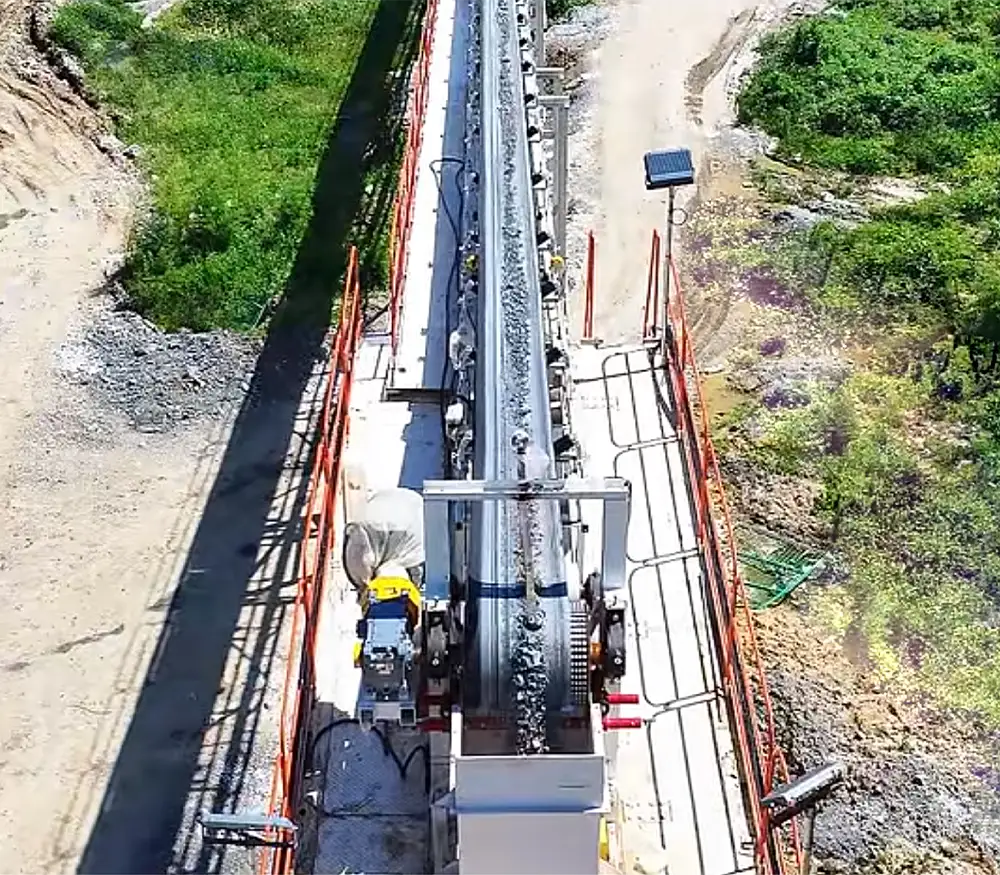
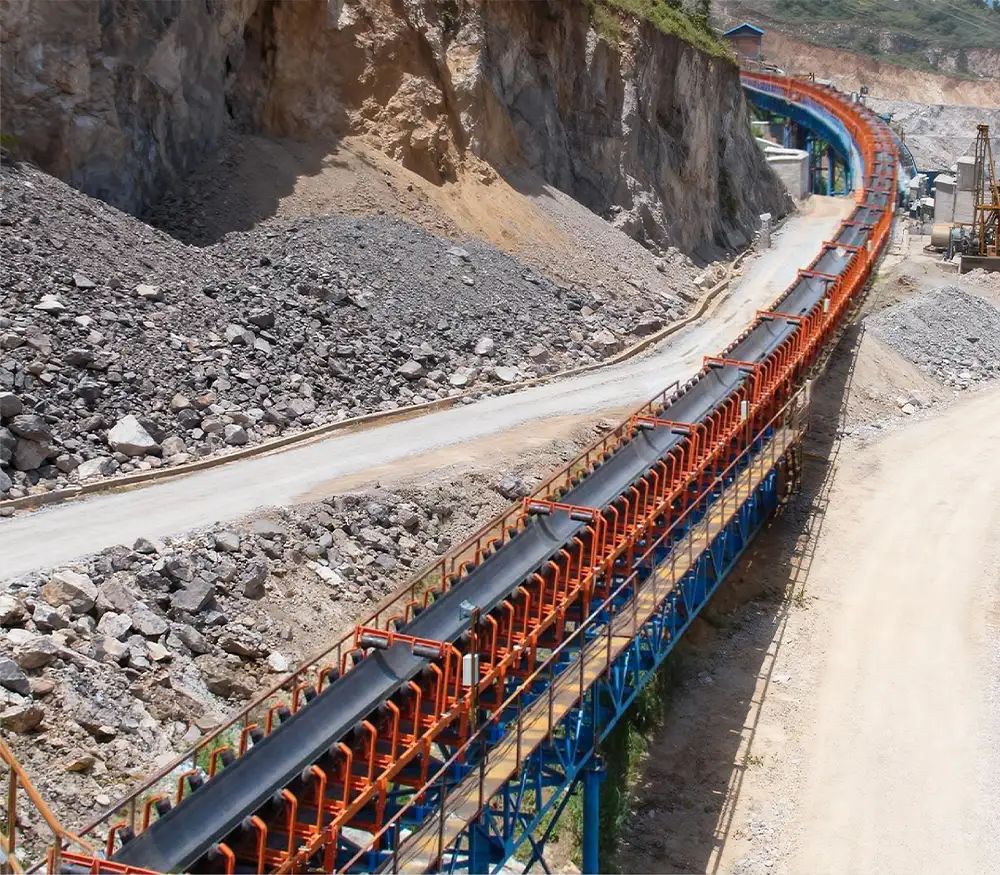
STE-High Elongation Steel Cord Conveyor Belt
-
Description
Overview
The STE High Elongation Steel Cord Conveyor Belt offers a viable replacement for traditional heavy duty fabric conveyor belts. It supports energy efficient operation and fits conveyor layouts with tight turning radii. This belt addresses several common pain points seen with regular fabric belts: limited elongation, poor troughing performance and recurring belt mistracking issues.
Many existing conveyor systems run into real world operational troubles when running fabric belts. Under heavy bulk material loads, fabric belts will stretch too much and require frequent tension adjustments. Some conveyor lines include bends and sharp curves, where conventional fabric belts cannot perform reliably — forcing costly large scale modifications to the whole conveying system.
Our STE high elongation steel cord belt delivers high tensile strength while keeping overall belt weight low. Most importantly, it can run on your existing conveyor framework without major mechanical rework. It lowers system load, cuts power consumption and helps reduce total capital investment for your bulk material conveying lines.
What Makes the STE Belt Different
This belt was engineered to deliver steel cord level tensile strength while staying flexible enough for curved paths and smaller pulleys, cutting excess dead load on your conveyor framework.
The warp direction adopts a 4×7 high elasticity steel cord arrangement. The open cord structure allows full rubber penetration, while the cord density meets strict high breaking load requirements. This special cord layout delivers two performance features rarely found together in one belt: high tensile rigidity under steady working loads, plus sufficient longitudinal stretch to absorb impact energy from falling materials.
During manufacturing, steel cords are laminated under tension and hot vulcanized inline following DIN and ISO standards. We tightly manage the vulcanization cycle to keep consistent bonding between steel cords and rubber compounds. Good cord to rubber bonding is critical not only for initial belt strength but also for long term splice service life.
Key Features
Weight reduction without sacrificing strength
Compared to standard steel cord belts of equal rating, the STE belt’s carcass design reduces mass per running meter. A lighter belt brings lower rolling resistance, less motor load and reduced wear on idler bearings. This advantage matters significantly for long overland conveyor applications.
High elasticity supports curved conveyor routing
Standard steel cord belts tend to resist bending. The STE design stays flexible enough for horizontal and vertical curves with small radii. Its good flexibility also improves troughing performance, letting the belt sit properly on steep angle idler sets.
Works with crowned pulleys for self centering operation
Belt mistracking is a persistent headache on curved conveyors or long center installations. The STE belt responds well to crowned pulley profiles to achieve self centering during operation. This reduces edge wear and cuts down on constant manual alignment work.
Compatible with smaller pulleys to lower equipment costs
Thanks to improved bending performance, the STE belt can be fitted to smaller drive and tail pulleys, without exceeding steel cord fatigue limits. This allows you to select smaller pulley diameters and bearing assemblies, cutting capital costs for new conveyor builds or retrofitting existing lines.
Reliable splice performance under cyclic loading
The belt supports hot cure finger splice joint configurations. This joint layout spreads tension evenly across the splice zone and delivers longer fatigue service life versus conventional stepped splices. The benefit stands out on conveyors with frequent start stop cycles.
Technical Specifications
| Item | Details |
| Reinforcement Member | 4*7 highly elastic permeable steel cords |
| Manufacturing Standard | DIN / ISO standard |
| Available Splicing Method | Hot cure finger splicing |
| Belt Width | Custom made per project requirement |
| Cover Rubber | Customizable: abrasion resistant, heat resistant, fire retardant, oil resistant |
| Main Application Scope | Surface conveyor systems |
| Core Advantage | High elongation, small curve radius adaption, fabric belt replacement |
Applications
STE belt is not a universal use conveyor belt. It is selected for scenarios where fabric belts lack sufficient elongation or troughing capability, yet full spec standard steel cord belts would be over engineered and overly stiff.
Typical working sites include:
- Mining: Overland conveyors running across undulating terrain
- Steel plants: Hot material transportation with heavy impact zones
- Harbours: Ship loading and stockyard conveyors with tight turning radii
- Cement plants: Long inclined conveyors for handling abrasive raw mix
- Power stations: Coal feed lines and ash disposal conveying systems
- Grain & salt processing: Low contamination sanitary material transport
- Surface conveyor networks: Complex layouts where straight routing is not practical
A frequent question raised by site engineers: Can I switch from fabric belt to steel cord belt without replacing pulleys or drive units?
For most projects, the STE belt makes this possible. Its high elasticity and lightweight design will not add extra bending resistance to your drive system. Its troughing performance matches or outperforms multi ply fabric belts. In most retrofits, existing idler spacing and pulley diameters can stay within operational specifications.
Why Engineers Choose the STE Over Fabric or Standard Steel Cord Belts
| Requirement | Fabric Belt | Standard Steel Cord Belt | STE Belt |
| High tensile strength | Limited | Yes | Yes |
| Curve adaptability | Good | Poor | Yes |
| Lightweight | Yes | No | Yes |
| Small pulley compatibility | Yes | No | Yes |
| Splice fatigue life | Moderate | High | High |
| Retrofit into existing system | N/A | Often requires modifications | Drop in compatible |
Need project specific sizing, cover rubber selection or splice design support? Send us your conveyor layout and load data. Our engineering team can deliver a performance comparison report against your current belt specification within two working days.
FAQ
Q1: Can STE high elongation steel cord conveyor belt directly replace my existing fabric conveyor belt?
A: For most surface conveying applications, yes. It serves as a drop in replacement and only needs minor adjustments to your existing conveyor system. For conveyors with special layouts, an on site condition assessment is still recommended.
Q2: What splicing method is recommended for STE belt?
A: Hot cure finger splicing is the recommended solution. It provides high splice strength and extended fatigue life. On site finger splice installation must be completed by professional field construction teams.
Q3: Is this steel cord belt suitable for small curve radius conveyors?
A: Yes. Good adaptability for small radius curves is one of its core selling points, setting it apart from regular steel cord conveyor belts.
Q4: Can I customize the cover rubber property to fit my working conditions?
A: Absolutely. Cover rubber compounds can be adjusted for abrasion resistance, heat resistance, fire resistance or oil resistance, based on conveyed materials and site ambient conditions.
Q5: Does STE belt require special pulleys?
A: It works well with crowned pulleys to realize self alignment and prevent belt mistracking. It also supports smaller diameter pulleys compared with many traditional conveyor belts.
Q6: What applications are not suitable for the standard STE series?
A: The standard STE belt is designed for surface conveying. Underground mining or operating conditions with extreme heavy impact will require extra customized rubber reinforcement.
Products

Sidewall Conveyor Belt

Pocket Type Conveyor Belt
It handles ultra high lift, high throughput tasks beyond conventional high angle sidewall belts, realizing stable continuous bulk material transportation.

Rope-track Sidewall Conveyor Belt

Bucket Elevator Conveyor Belt
They deliver low elongation, high throughput and stable operation with easy maintenance, helping operators reduce downtime from belt failures and frequent replacements.

Pipe Conveyor Belt
Supporting sharp horizontal and vertical bends, it meets strict environmental requirements and helps plants remove redundant transfer points, favored by operators troubled by on site dust and leakage issues.

Chevron Conveyor Belt
Various chevron patterns are available for different slope demands. Widely used in mining, farming, construction and recycling, it maintains stable performance under harsh on site working conditions.
Recent news

Sidewall Conveyor Belt Sagging Solutions: QBF rubber Free Zone Base Belt Design Extends Service Life by 30%
Sep 18, 2026

QBF Rubber Anti-stick Sidewall Belting Helps Shenzhen Tunnel Construction
Sep 18, 2026

Mining Vertical Lifting System Solution: Tackling Continuous Conveying Challenges for Deep-Mine Operations
Sep 17, 2026
See Latest Service





