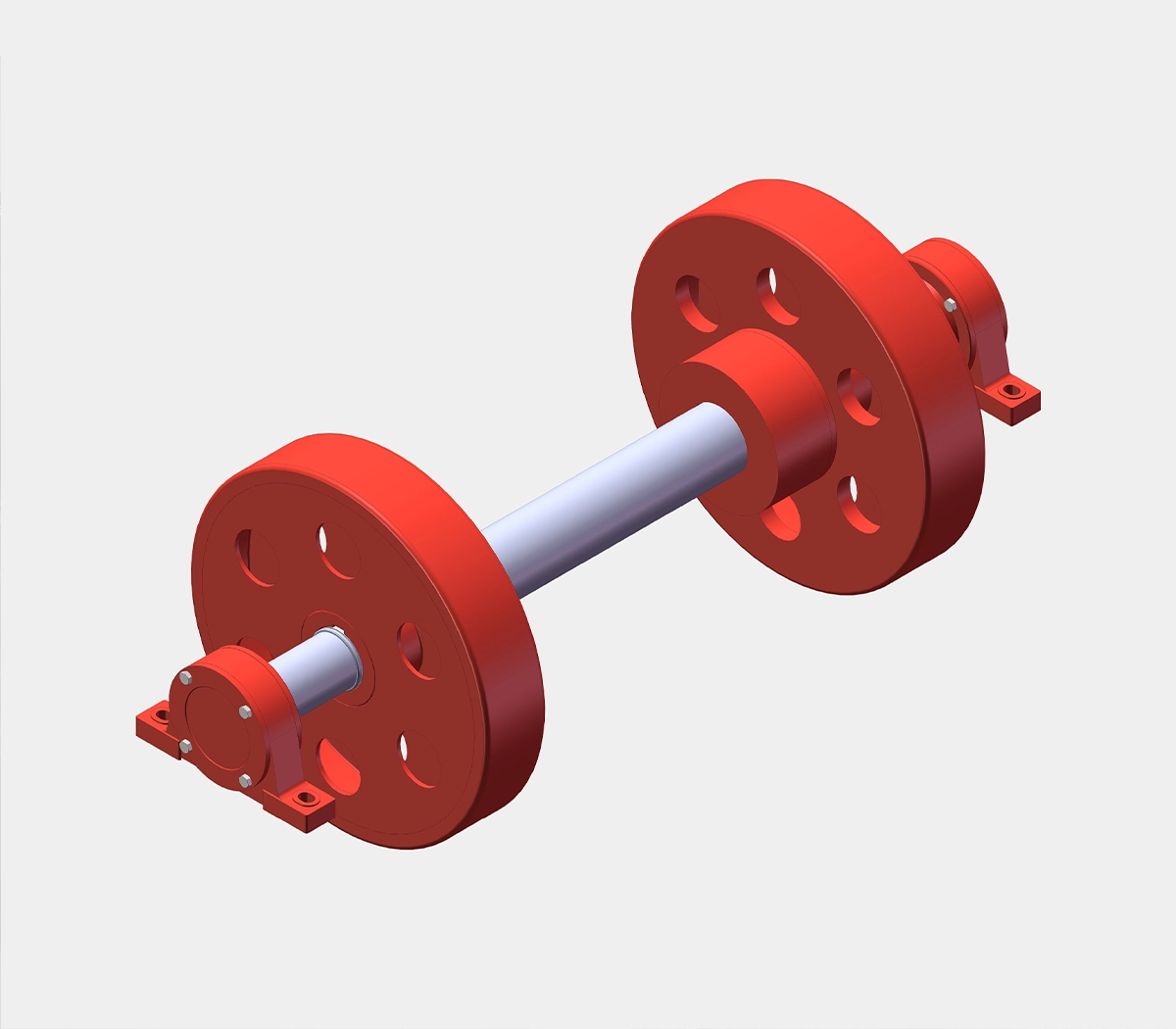
Deflection Wheel
-
Description
Product Overview
The deflection wheel, also referred to as hold down wheel or pressure pulley, is a critical spare part built for large angle corrugated sidewall belt conveyors. It sits within the conveyor’s convex arc transition zone.
When the conveyor shifts from horizontal run to steep inclined lifting, sidewall belts commonly float, drift, or lift off support rollers. This part addresses those field issues. It presses against the empty edge sections of the base belt to deliver smooth direction change, cutting operating drag and lowering risks of belt tearing and wear. Every unit is purpose built to fit corrugated sidewalls and cross cleats, ensuring these belt profiles pass through central clearance without pinching or scraping rubber surfaces.
Core Design Features
- R radius transition on wheel rim Curved rim surface removes sharp welded edges. It converts damaging line cutting contact into gentle surface to surface contact. This simple design upgrade prevents longitudinal cracking on the base belt — one of the top failure points for sidewall belts in bulk material work.
- Removed inner rigid wheel structure Matches the natural transverse rigidity of the base belt. Eliminates harsh rigid on rubber friction and extends usable belt life out in the field.
- Application oriented custom fabrication Wheel diameter, face width and inner clearance width get sized to match real world conveyor parameters: belt width, trough angle, sidewall height and cleat dimensions. Each set fits the running belt exactly. No forced squeezing against sidewalls or cleats.
Practical tip: Do not reuse deflection wheels pulled from other conveyor models. Mismatched clearance will quickly chew through expensive sidewall rubber.
Main Functions
- Hold down belt & stop belt floating: Acts directly on belt empty edges. Stops floating, slipping and roller lift off at convex arc sections.
- Smooth redirection: Creates a gentle path shift for belt travel. Cuts excess running drag and stabilizes overall conveyor performance.
- Belt protection against crack & wear: R corner geometry eliminates sharp cutting points. Reduces longitudinal splits on base belt, limits sidewall chipping and surface abrasion.
- Bypass clearance for sidewall & cleats: Central gap lets corrugated sidewalls and cross cleats move through freely, no impact collisions.
Structure Composition
Press wheel assemblies come in several layouts: paired large small wheel sets, single wheel or dual wheel builds. Larger wheels handle belt pressing duties; inner small wheels provide lateral guidance.
Each press wheel uses standalone bearing units. Inner guide wheels in particular run on separate bearings for free independent rotation. This avoids forced friction caused by speed mismatch between wheel and rubber sidewall.
Wheels mount to main shaft, bearing housings and support brackets. Field technicians can fine tune positioning during installation. Wheel faces are supplied flat or angled with chamfer / R radius finishing, reducing wear on belt empty edge and corrugated sidewall.
Practical tip: Spin each wheel by hand after installation. Any stiff rotation means bearings need inspection before startup.
Common On site Problems & Practical Optimization Tips
Lots of premature belt damage traces back to poor deflection wheel selection or incorrect setup, not original belt quality.
Sidewall heavy wear & rubber deformation
Root cause: Insufficient clearance between wheel inner side and corrugated sidewall; sidewall stays under constant squeeze. Fix: Adjust clearance to near contact status with no hard squeezing. Leave room for sidewall movement under loaded operating conditions.
Sidewall cracking and chipping
Root cause: Large wheel and inner small guide wheel welded as a single assembly. Different linear speeds during operation scrape rubber sidewall continuously. Fix: Install split type wheel construction. Fit independent bearings so inner guide wheels rotate on their own.
Base belt longitudinal cracking along empty edge
Root cause: Sharp square rim edges creating line cutting friction against belt margins. Fix: Machine full R radius transitions on all wheel edges. Swap sharp edged bevel wheels for flat wheels with rounded corners.
Aggravated friction when belt drifts
Root cause: Poor alignment between wheel mounting position and existing belt tension. Fix: Tweak deflection wheel position alongside conveyor belt tension calibration. Minimize extra friction triggered by belt mis tracking.
Practical tip: Watch belt edges for fresh rubber dust. Heavy dust build up signals excessive contact pressure that needs immediate adjustment.
Application Scope
Deflection wheels operate on large angle corrugated sidewall belt conveyors across multiple bulk material industries: coal mining, chemical processing, metallurgy, building materials, grain handling and sludge treatment.
They suit steep incline or vertical lifting work for ore, coal, grain pellet, sludge, crushed stone and other granular or lumpy bulk goods.
Why Our Deflection Wheel Works For Your Conveyor
Every deflection wheel we supply gets dimensioned around your actual conveyor setup. We match belt width, trough angle, sidewall and cleat dimensions for each order. Full R radius rim transition is standard to help guard against costly base belt longitudinal cracking out on site. Split construction with independent guide wheel bearings removes forced scraping against rubber sidewalls. Heavy duty support structures keep steady operation and lower ongoing maintenance work. These units hold up well under punishing mining, metallurgy and other heavy bulk material operating environments.
FAQ
Q1: Where should deflection wheels be mounted on sidewall conveyor?
A: Install these wheels primarily on the convex arc transition segment where horizontal sections feed into steep inclined lifting zones. They are not meant for straight run conveyor sections. Wrong placement introduces unnecessary belt wear.
Q2: Shall deflection wheel tightly press against belt edge?
A: Tight hard pressing accelerates rubber fatigue. Target near touch contact without heavy compression. The wheel only activates as the belt starts floating upward.
Q3: Can one size fits all deflection wheel work for different sidewall belts?
A: We advise against generic off the shelf units. Wheel diameter and inner gap width must align with your belt width, sidewall height and cleat size. Poor fit will scratch sidewalls or remove anti float performance. Custom sizing delivers better long term results.
Q4: What are the early warning signs that deflection wheels need inspection or replacement?
A: Keep an eye on these field indicators: visible scratch marks on belt empty edge or sidewall; wheels that cannot spin freely by hand; abnormal bearing noise; frequent sidewall rubber chipping. Schedule checks within your standard maintenance cycle.
Q5: Can I keep using welded integrated large small wheel assembly?
A: Not recommended. Speed differences create persistent scraping damage on sidewall rubber. Split type assemblies with independent bearings extend service life for both deflection wheel and conveyor belt.
Products

Sidewall Conveyor Belt

Pocket Type Conveyor Belt
It handles ultra high lift, high throughput tasks beyond conventional high angle sidewall belts, realizing stable continuous bulk material transportation.

Rope-track Sidewall Conveyor Belt

Bucket Elevator Conveyor Belt
They deliver low elongation, high throughput and stable operation with easy maintenance, helping operators reduce downtime from belt failures and frequent replacements.

Pipe Conveyor Belt
Supporting sharp horizontal and vertical bends, it meets strict environmental requirements and helps plants remove redundant transfer points, favored by operators troubled by on site dust and leakage issues.

Chevron Conveyor Belt
Various chevron patterns are available for different slope demands. Widely used in mining, farming, construction and recycling, it maintains stable performance under harsh on site working conditions.
Recent news

Sidewall Conveyor Belt Sagging Solutions: QBF rubber Free Zone Base Belt Design Extends Service Life by 30%
Sep 18, 2026

QBF Rubber Anti-stick Sidewall Belting Helps Shenzhen Tunnel Construction
Sep 18, 2026

Mining Vertical Lifting System Solution: Tackling Continuous Conveying Challenges for Deep-Mine Operations
Sep 17, 2026
See Latest Service





